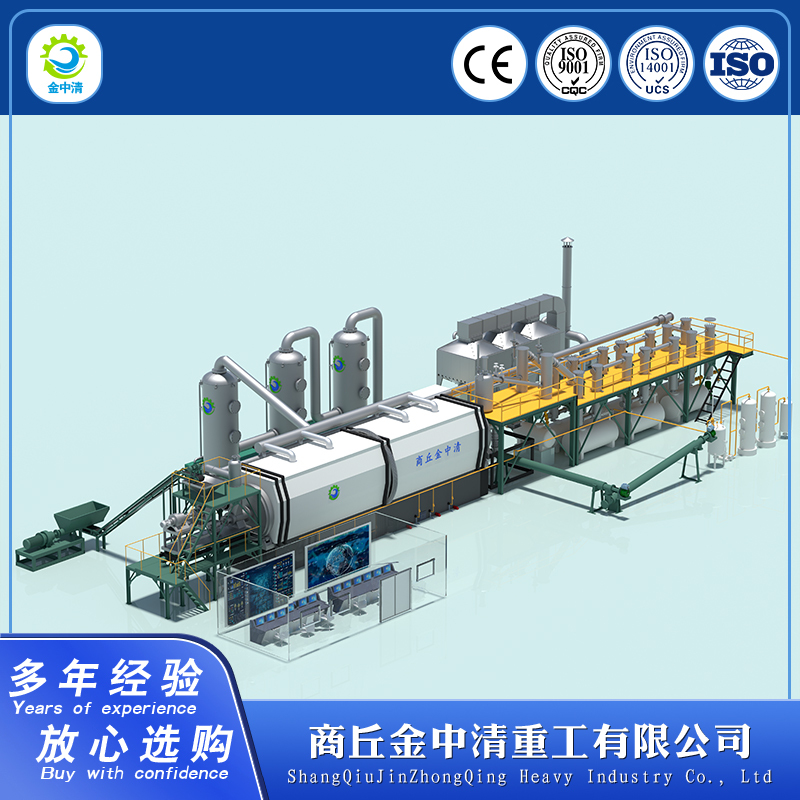
Continuous cracking treatment project of waste tires
Continuous cracking treatment project of waste tires
- Detail
- Parameters
Waste tire treatment project
Project Development Background
The environment in which people live is deteriorating, and pollution has become a topic of growing concern. There is a large amount of man-made garbage all over the world. From the United States to Africa, all kinds of waste electrical parts, plastic waste, tires, etc. have been found in rivers and seas. Among them, the pollution problem of tires has become increasingly prominent. In addition to the waste gas and wastewater pollution generated during the production process of tires, the increasing number of waste tires is causing serious "black pollution" to the earth, posing a great challenge to environmental protection.
According to professionals, tires are made of infusible or refractory polymer elastic materials. It will take hundreds of years for the macromolecules of these materials to decompose to a level that does not affect the growth of plants in the soil. However, landfilling, burning and other methods of dealing with solid waste are not applicable to waste tires. Therefore, how to deal with waste tires has always been a recognized environmental problem in the world.
The increasing amount of waste tires on the earth are piled up in the open air for a long time, which not only occupies a large amount of land resources, but also breeds mosquitoes and spreads diseases, seriously deteriorates the natural environment, destroys plant vegetation, seriously endangers the earth's ecological environment, and may cause fires, threatening people's lives and property safety. In some areas, waste tires are used as fuel, and the serious pollution has left no grass growing around them.
The main methods for treating waste tires are:
① Overall recycling. Tire retreading refers to a process of using old tires to restore their use value after partial repair, processing, re-covering tread rubber, and then vulcanization. In Germany, the retreading of passenger car tires is 12%, and that of truck tires is 48%. The total output of retreaded tires is 10,000 tons per year. The quality of domestic tires in my country is generally low, and most waste tires have no retreading value. Waste tires can be used as ship buffers at docks, as road guardrails or soil and water conservation fences, and as building sound-absorbing partitions.
② Manufacturing recycled rubber. Recycled rubber refers to waste rubber that has been subjected to physical and chemical processes such as crushing, heating, and mechanical treatment to change its elastic state into a rubber that is plastic and sticky and can be re-vulcanized. ③ Production of rubber powder. Applications of rubber powder: One is used in the rubber industry, directly molded or used with new rubber to make products; the other is used in modified asphalt pavement, modified asphalt production of waterproof membranes, and used as coatings and protective layers in the construction industry. The crushing processes for producing rubber powder include ozone crushing, high-pressure blasting crushing, and low-temperature fine crushing.
④ Burning tires provides a large amount of heat to support combustion.
Comparison of treatment methods: The most widely used method in China is to produce recycled rubber from waste tires. The product obtained has good plasticity, but the molecular chain of the recycled rubber is greatly damaged, the molecular weight is low, and it is very uneven. Practice shows that the use of waste rubber to produce recycled rubber not only consumes a lot of energy in the production process, but also the performance indicators of the vulcanized rubber in the recycled rubber are not as good as those of the waste tires before treatment. It also has the disadvantages of high energy consumption, low added value, and prominent secondary pollution problems.
The incineration process can recover the heat contained in waste tires at one time, but its equipment cost is high and it is easy to cause secondary pollution. Extracting valuable chemical products after cracking is a newer way to reuse waste tires. This method can produce high calorific value fuel gas and various petroleum products and carbon black. However, its processing cost is quite high, and the recovered products are very uneconomical compared with the current market prices of petroleum, carbon black, etc., and secondary pollution and other issues need further research.
The production of rubber powder does not require the desulfurization and annealing processes in the production of reclaimed rubber. The process is much simpler than the traditional reclaimed rubber production process, and can save 40% energy and more than 80% water. It can save a lot of manpower, material resources and power, and greatly reduce the cost of equipment investment. There is no pollution from wastewater, waste gas and dust, and secondary pollution can be basically eliminated. The production of rubber powder makes full use of the available part of waste rubber, which can not only reduce the cost of rubber products, but also fully recycle waste rubber resources. In addition, the application range of rubber powder is very wide, which can meet the needs of many aspects.
Shangqiu Zhongqing Environmental Protection Waste Tire Treatment Equipment Description:
Equipment advantages:
1. Continuous production can reach more than 30 days, and plastic sludge and oil sand can be produced continuously for more than 45 days.
2. The cracking furnace body adopts a heat storage structure to fully recycle the waste heat, which can not only extend the service life of the main furnace, but also save fuel, thereby further saving production costs.
3. The equipment is equipped with a self-developed infrared anti-blocking warning and dredging device. This device is an exclusive anti-blocking warning device developed by our company. It will warn of pipeline blockage during the production process and automatically solve the blockage problem, ensuring that the main furnace will not have safety problems due to pipeline blockage during the production process.
4. Use a new type of exhaust gas purification system to ensure that the purified exhaust gas meets the relevant national emission standards.
5. The furnace core is made of special high temperature resistant boiler steel with a service life of up to 8 years.
6. The accelerator independently developed by the company increases the oil yield by 3%-8% after use.